

There’s nothing worse than turning on your car’s air conditioning on a scorching summer day — only to feel warm, musty air blowing back at you. Whether your AC is blowing hot air, making strange noises, or simply not cooling as well as it used to, this guide covers every cause, every symptom, and every solution in plain English.
Unlike other guides, we go beyond the basics. You’ll find exact cost ranges by component, a clear breakdown of what you can fix yourself versus what needs a pro, and practical tips to prevent costly repairs before they happen.
Quick Answer
Car AC repair costs typically range from $150 to $1,500+ depending on the problem. A simple refrigerant recharge costs $150–$300, while a compressor replacement can run $800–$1,500. Catching the issue early almost always saves money.
How Your Car AC System Works
Your car’s air conditioning is part of a broader HVAC (Heating, Ventilation, and Air Conditioning) system. It doesn’t just blow cold air — it removes heat and humidity from the cabin by cycling refrigerant through a series of components.
Compressor
The heart of the AC system. Driven by a belt connected to the engine, the compressor pressurizes the refrigerant gas and sends it through the system. A failing compressor is the most expensive AC repair.
Condenser
Located at the front of the car, the condenser releases heat from the pressurized refrigerant, turning it from a hot gas into a warm liquid. It works much like a small radiator.
Receiver-Dryer / Accumulator
This component filters moisture and contaminants from the refrigerant before it moves on. Moisture in the AC system is extremely damaging — it forms corrosive acids that eat away at seals and metal parts.
Expansion Valve / Orifice Tube
Controls the flow of refrigerant into the evaporator, causing it to rapidly expand and cool down to near-freezing temperatures.
Evaporator
Hidden inside your dashboard, the evaporator is where the magic happens. The ice-cold refrigerant absorbs heat from the cabin air, and a blower fan pushes that cooled air through your vents.
Back to the Compressor
The refrigerant, now a warm gas again, returns to the compressor and the cycle repeats continuously — as long as your AC is running.
Why This Matters for Diagnosis
Each component can fail independently. Understanding how they connect helps you communicate better with your mechanic and avoid being overcharged for unnecessary repairs.
9 Warning Signs Your Car AC Needs Repair
Don’t wait until your AC completely stops working. These nine symptoms are your early-warning system — and catching them early can save you hundreds in repair costs.
1 Warm or Hot Air From Vents
The most obvious sign. Causes range from low refrigerant to a failed compressor or a blocked condenser. Never ignore this one.
2 Weak Airflow
If the air is cold but barely coming out, your blower motor, a clogged cabin air filter, or mold buildup in the evaporator case may be the culprit.
3 Musty or Foul Smell
A damp or mildew-like smell usually means mold or bacteria has grown inside the evaporator or on a dirty cabin air filter. Not just unpleasant — it affects air quality.
4 Clicking or Rattling Noises
A clicking sound when you turn the AC on often indicates a failing compressor clutch. Rattling could mean loose debris hitting the condenser or fan.
5 Hissing or Bubbling Sounds
These sounds typically point to a refrigerant leak. A hiss means high-pressure gas escaping; bubbling suggests moisture has entered the system.
6 Water Leaking Inside the Cabin
A blocked evaporator drain causes condensation to overflow onto your floor mats. Left unchecked, this leads to mold and electrical damage.
7 AC Cycles On and Off Too Rapidly
Known as “short cycling,” this is often caused by an overcharged system, a faulty pressure sensor, or low refrigerant levels.
8 AC Works Only at Higher Speeds
If your AC cools well on the highway but struggles at idle, your condenser fan or cooling fan may not be working correctly.
9 Visible Oily Residue Near AC Lines
Refrigerant carries compressor oil. An oily stain around AC fittings, hoses, or under the hood is a strong sign of a refrigerant leak.
Don’t Delay — Low Refrigerant Destroys Compressors
Running an AC system with insufficient refrigerant starves the compressor of lubrication. What starts as a $200 recharge can become a $1,200 compressor replacement if ignored for too long.
Common Causes of Car AC Problems
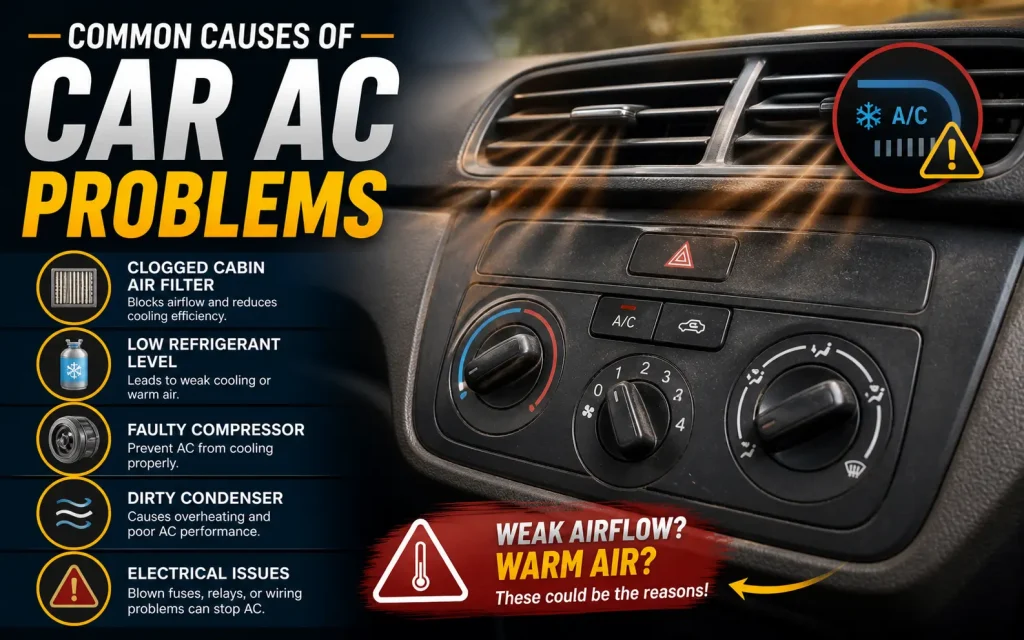
Refrigerant Leaks
Refrigerant doesn’t “run out” naturally — if levels are low, there’s always a leak somewhere. Common leak points include O-ring seals, hose fittings, the condenser, and the evaporator core. A UV dye test or electronic leak detector is the standard method professionals use to find them.
Compressor Failure
The compressor is the most expensive AC component to replace. It can fail due to: running with low refrigerant, a seized clutch, internal wear over time, or contaminated refrigerant. Always replace the receiver-dryer alongside the compressor to protect your new unit from contaminants.
Condenser Damage
Located at the front of the car, the condenser is vulnerable to road debris. Even a small crack or bent fin significantly reduces cooling efficiency. In some cases, a damaged condenser is repairable; in others, replacement is the only option.
Clogged or Dirty Cabin Air Filter
This is the most overlooked AC issue — and the cheapest fix. A clogged cabin filter restricts airflow so severely that even a perfectly functioning AC system will underperform. Replace it every 15,000–25,000 miles, or annually if you drive in dusty conditions.
Faulty Blend Door Actuator
This small motor controls the mix of hot and cold air inside your HVAC system. When it fails, you may get heat on one side and cold on the other — or the temperature won’t respond to adjustments at all. Many drivers mistake this for a refrigerant problem.
Electrical or Sensor Failures
Modern AC systems rely on pressure sensors, thermostats, relays, and control modules. A faulty sensor can prevent the compressor from engaging even when everything else is fine. A proper diagnostic scan is essential before replacing parts.
Evaporator Core Leaks
The evaporator is tucked deep inside the dashboard, making it one of the most labor-intensive repairs. Symptoms include a sweet smell (refrigerant odor), film on the inside of the windshield, or water on the floor. Expect a high labor bill if this needs replacing.
- Basic AC recharge ki starting cost: $150
- 6+ key components AC failure ka sabab ban sakte hain
- Recommended AC inspection interval: 1 yr
- Fuel economy impact of a malfunctioning AC: 20%
Car AC Repair Costs: Full Breakdown
One of the biggest complaints drivers have about AC articles is the lack of real cost information. Here’s a detailed breakdown of what you can expect to pay, including parts and labor, at an independent shop in 2025. Dealership prices typically run 20–40% higher.
| Repair / Service | Parts Cost | Labor | Total Range | Urgency |
|---|---|---|---|---|
| Cabin Air Filter Replacement | $15–$45 | $0–$30 | $15–$75 | Low |
| AC Recharge (Refrigerant Refill) | $50–$150 | $80–$150 | $150–$300 | Moderate |
| O-Ring / Seal Replacement | $10–$50 | $100–$200 | $150–$350 | Moderate |
| Condenser Fan Replacement | $80–$200 | $100–$200 | $200–$450 | Moderate |
| Blend Door Actuator | $20–$100 | $150–$300 | $200–$450 | Moderate |
| Condenser Replacement | $100–$400 | $150–$300 | $300–$700 | High |
| Compressor Replacement | $400–$900 | $300–$600 | $800–$1,500 | High |
| Evaporator Core Replacement | $100–$400 | $50–$1,000+ | $700–$1,500+ | High |
| Full AC System Flush + Recharge | $50–$150 | $100–$200 | $200–$400 | Moderate |
When to Consider Replacing vs. Repairing
If repair costs exceed 50% of your car’s current market value — or if multiple components need replacing at once — it may be more economical to replace the vehicle. Always get two or three quotes before committing to any repair over $500.
Does a Broken AC Affect Fuel Economy?
Yes — and more than most people realize. A malfunctioning or inefficient AC system forces the compressor to work harder, which draws extra power from your engine. Studies suggest a failing AC system can reduce fuel efficiency by up to 20% in stop-and-go traffic. Getting it repaired promptly doesn’t just restore your comfort — it saves money at the pump too.
DIY vs. Professional Car AC Repair
Some AC fixes are well within the ability of a weekend DIYer. Others absolutely require specialized equipment and a certified technician. Here’s the clear breakdown:
SAFE TO DIY
- Replacing the cabin air filter
- Checking and cleaning AC vents
- Cleaning condenser fins (carefully)
- Using an AC recharge kit (R-134a only, with caution)
- Replacing a condenser fan fuse or relay
- Adding UV dye for leak detection
LEAVE TO A PROFESSIONAL
- Refrigerant recovery and recharge (legal requirement)
- Leak diagnosis with electronic detectors
- Compressor replacement
- Evaporator core replacement
- Condenser replacement (with system flush)
- Electrical diagnosis and sensor replacement
Important Legal Note on Refrigerant
In the U.S., it is illegal to intentionally vent refrigerant into the atmosphere. Recovering and recharging AC refrigerant requires EPA Section 609 certification and specialized recovery equipment. Never attempt to vent and recharge a system yourself.
About DIY AC Recharge Kits
Those $30–$50 AC recharge cans at auto parts stores can be a tempting quick fix. They work in some situations — but come with real risks. Overfilling the system is very easy to do without professional gauges, and an overcharged AC can destroy the compressor. They also don’t fix leaks; they just temporarily mask them. Use with care, and only as a stopgap.
Refrigerant Types: R-134a vs. R-1234yf
Most drivers have no idea there are different types of refrigerant — and using the wrong one will damage your system. Here’s what you need to know:
R-134a (HFC-134a)
The standard refrigerant used in most vehicles built before 2015. It’s widely available and relatively inexpensive. However, it has a high global warming potential (GWP of 1,430), which led to regulations mandating a phase-out in new vehicles.
R-1234yf (HFO-1234yf)
Mandated in new passenger vehicles in the U.S. and Europe from 2013 onward (phased in by manufacturer). R-1234yf has a GWP of just 4 — over 300 times less than R-134a. The downside? It costs significantly more per pound (often $40–$80/lb vs. $10–$20/lb for R-134a) and requires dedicated equipment.
How to Know Which Refrigerant Your Car Uses
Check under the hood — there’s a sticker on the AC components (usually on the compressor or near the underhood area) that states the refrigerant type and capacity. Your owner’s manual will also specify it. Never mix refrigerant types.
Seasonal Car AC Maintenance Tips
When you service your AC matters almost as much as how you service it. Different seasons bring different challenges:
Spring
The best time for a full AC performance check. Have refrigerant levels tested, belts inspected, and the cabin filter replaced before summer heat arrives.
Summer
Run the AC on high for 5–10 minutes once a week — even if it’s not hot — to keep seals lubricated and circulate refrigerant oil through the system.
Fall
Check the cabin air filter after pollen and dust season. Run the AC briefly while using the defrost setting to clear fogged windows and prevent mold buildup.
Winter
Don’t skip the AC in winter. Running it with the heater helps dehumidify the cabin and deice windows faster. It also keeps the compressor seals from drying out during months of inactivity.
How to Extend Your Car AC’s Life
Preventive maintenance is far cheaper than reactive repair. These habits will add years to your AC system:
| Action | Description |
|---|---|
| Run the AC regularly | At least once a week for 10 minutes, year-round, to lubricate compressor seals and prevent refrigerant from settling. |
| Replace the cabin air filter on schedule | Every 15,000–25,000 miles — or every year if you live in a dusty or high-pollen area. |
| Have the system inspected annually | A spring AC check-up catches low refrigerant and leaks before they cause expensive damage. |
| Park in the shade | Excessive heat accelerates the degradation of rubber seals and hoses in the AC system. |
| Ventilate before cooling | After the car heats up in the sun, open the windows for 30–60 seconds before switching on the AC. This expels the hottest air and reduces the load on the system. |
| Keep the condenser clean | Bugs, leaves, and debris clog condenser fins and reduce heat transfer. A gentle rinse from a garden hose (not a pressure washer) can help. |
| Don’t max the AC immediately | Give the system a moment to build pressure before cranking it to the coldest setting, especially on a hot day. |
| Address strange smells early | A musty smell that’s left untreated leads to mold growth in the evaporator — a much costlier fix than running an antibacterial treatment early on. |
How to Find a Trustworthy AC Mechanic

Your AC system is complex and expensive. Choosing the wrong shop can cost you hundreds in unnecessary repairs. Here’s how to protect yourself:
Look for These Credentials
- ASE Certification (Automotive Service Excellence) — particularly the A7 (Heating and Air Conditioning) certification.
- EPA Section 609 Certification — required by law for anyone handling refrigerants.
- Shops that use a manifold gauge set or digital manifold to diagnose — not just visual inspection.
Questions to Ask Before Authorizing Repairs
- “What diagnostic tests did you perform, and what did they show?”
- “Can I see the results of the pressure test or leak detection?”
- “Is this a genuine OEM or aftermarket part? What’s the warranty?”
- “Will you perform a system evacuation and recharge after the repair?”
- “What’s included in this quote — parts and labor?”
Always Get the Diagnosis Before Authorizing Repairs
A trustworthy shop will perform a proper diagnostic check — usually $50–$100 — before recommending repairs. Be wary of any shop that immediately quotes a compressor replacement without running pressure tests or a leak check.
A Note on Electric and Hybrid Vehicles
If you drive an electric or hybrid vehicle, your AC system works differently. Many EVs use an electric-driven compressor that operates independently of the engine — which means it can cool the cabin even when parked and charging. However, it also means the AC draws directly from the high-voltage battery, affecting range. Always have EV AC service performed by a technician trained in high-voltage systems.
Frequently Asked Questions
How long does a car AC repair typically take?
It depends on the repair. A basic recharge or cabin air filter swap takes 30–90 minutes. Compressor replacement typically takes 3–6 hours. Evaporator core replacement — the most labor-intensive job — can take 6–12+ hours because the entire dashboard often needs to be removed.
Why does my car AC smell bad when I first turn it on?
That musty smell is typically mold and bacteria growing on the evaporator core — a warm, damp environment that’s perfect for microbial growth. First, replace the cabin air filter. If the smell persists, an evaporator antibacterial treatment (available at auto shops) sprayed through the vents can help. Persistent smells may indicate a partially blocked evaporator drain.
How often should I recharge my car AC?
A healthy AC system should not need frequent recharging. Refrigerant doesn’t get “used up” — it circulates in a closed system. If your AC regularly needs recharging, that means there’s a leak somewhere that needs to be fixed. A properly sealed system can go 7–10+ years without needing a recharge.
Can I drive my car if the AC isn’t working?
Yes, your car will drive fine without AC. However, in extreme heat, cabin temperatures can reach dangerous levels — a safety risk, especially for children and pets. Also, ignoring AC problems can lead to more expensive damage over time (e.g., a low-refrigerant situation damaging the compressor). Get it checked soon rather than later.
Why does my AC only work when the car is moving?
This is a classic sign that your condenser fan or cooling fan isn’t working. At highway speeds, airflow over the condenser is sufficient to cool it. At idle, you need the fan to do that job. Have the fan motor and its fuse/relay checked first — it’s often a simple fix.
Does using AC reduce gas mileage?
Yes. Running the AC compressor draws power from the engine, which increases fuel consumption — typically by 5–15% under normal conditions, and up to 20% with a struggling or inefficient system. At highway speeds above 50 mph, using AC is actually more fuel-efficient than opening windows (which increases aerodynamic drag).
What is an AC evacuation and recharge?
An AC evacuation and recharge is the standard professional service for AC systems. The technician connects specialized equipment to remove (recover) the old refrigerant, then creates a deep vacuum in the system to remove all moisture and air. Finally, they refill the system with the precise amount of refrigerant specified by the manufacturer. This is not the same as a DIY top-off kit.
Is it worth fixing the AC on an older car?
It depends on the repair cost relative to the car’s value. A $200 recharge on a $5,000 car is almost always worth it. A $1,200 compressor replacement on a $3,000 car needs more thought. Ask yourself: is the rest of the car in good condition? Would you spend that money on this car for any other reason? Get a full vehicle inspection before committing to major AC repairs on a high-mileage vehicle.
